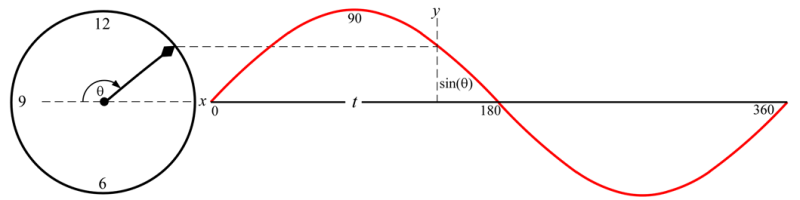
Space, time and number are concepts better explained by logic than physics. Logic is a way of reasoning that exposes indubitable facts without need of physics, e.g. “if y is greater than x and w is lesser than x, then y is greater than w.” Physics does not discover such logical forms of reasoning; it applies them to the objects of experience.
Unlike logical rules, physical “laws” are built upon temporal notions such as velocity, frequency and momentum. So, physical explanations of what time “is” are bound to be circular, even if they appeal to the results of experiments. At best, those experiments can only show that the logic applied by physicists fits well with experience and observation.
Let’s then return to the drawing of the line interval above. The consideration of a drawn line suggests the following: Spatial relationship is defined by an apparent juxtaposition of objects: A and B together. Temporal relationship is defined by sequencing: an object appears at position A earlier than it appears at B.
A linear sequence of objects is ordered like the alphabet in the sense that A is before B if we recite forwards, but B is before A if we recite backwards. Yet this notion of before and after ordering cannot properly be applied to a sequence of events, because we do not allow that later events can appear before earlier ones. The activity of counting helps to explain this. Consider the difference between:
- 0 is before 3 in the set of all natural (counting) numbers
- 0 is before -3 in the set Z of all integers (whole numbers either side of 0).
What makes statement a) true is that a simple add one rule generates the entire N-series { }, {I}, {I, I}, {I, I, I}…, as a limitless one-way expansion from an empty set { } = 0. Statement b) is true because Z comprises of successive pairs of integers where ‑z + z = 0. Since Z expands from 0 in both plus and minus directions, there are no limit +z or –z values from which to start a process of subtraction that leads back to 0.
Hence, counting forward or backward from 0 exposes N and Z series that always expand and never contract. And any alternating pattern of adding and subtracting that generates a z sequence such as {0, -1, -2, -1, 0, 1…} requires exactly the same number of logical operations as is required to take us from 0 to 5 in N.
Operations that move us from one place in a sequence to another are events. Since counting is a series of events, we need the terms earlier and later instead of before and after to describe the ordering of that series, because the total number of counting actions that bring us to any place along the Z line cannot be reduced by a next counting action.
Strangely, these obvious features of the counting “journey” along the Z line don’t dissuade physicists from thinking that earlier-later ordering somehow requires a physical explanation. Many insist that event sequences map to a before and after notion of the Z series because Newton’s laws of motion remain the same regardless of whether we choose to read the journey of a relatively moving body in a +t or a –t direction.
But those symmetries in Newton’s equations cannot explain why a timeline t always lengthens with each successive clock reading, even if the hands of a clock intermittently reverse direction. Nor do they explain why we doubt that any observer can truly detect physical event sequences running in the direction tomorrow → now.
Anyone who argues that this is due to some psychological inability to observe events later than now needs to explain why observational devices such as movie cameras also record events in exactly the same way. Can a camera photograph events later than now?
The concept of time describes a true difference between J situations where the opposing ends of an interval s appear juxtaposed, and S situations where our awareness of one end succeeds our awareness of the other. However, this undeniable truth about our perception of the intervals separating observed objects can be obfuscated by our view of how those objects move relative to one another.
Imagine that the events at either end of interval AB are two successive flashes of light in a dark room. S is essential to our determination of whether there are two light emitters E and F at either end of AB which each produce one flash, or whether both flashes are produced by one emitter E. A single emitter E that flashes at both A and B cannot correspond either with J, or with a later → earlier sequencing of events.
In order to explain how E could flash at both A and B, we can appeal to the concept of a relative motion between E and AB. However, that opens the door for philosophers and physicists to ask whether E really moves physically, because if they plot its path into an event map with x, t, axes, it shows that E “is present” at a succession of events, each one fixed at a position on the map which doesn’t change in any observer’s view.
It is this interpretation of the relationship between mapped events which gives rise to the block universe theory. For block-theorists, the world simply is an expanse of juxtaposed events, rather than a series of events that “become” now present and then past. They view the physical objects which trigger our sensory perceptions to be “already out there” as the components of a physical field which no one observer can see all at once. The fixed four-dimensional form of this field is only evident when comparing the viewpoints of all possible relatively simultaneous observers in it.
Thus, block theory reduces the relationship between events to the changeless one shown between A and B in my drawn line illustration. If I say that this line is something I created over time by drawing a pencil across paper, block theory says that what I’m actually describing is a pencil, paper and line that actually coexist over an interval longer than the short “now” which I use to distinguish things that are from things that were or will be.
Eternal Reality
Since numbers and geometric forms have unchanging properties, it’s natural to view them as components of a complete and changeless reality. Yet, as Plato early pointed out, we appear incapable of seeing this eternal reality in its entirety. Neither we, nor our computers pick the numbers out from an infinite list. Numbers and shapes are discovered by repeating certain kinds of logical operation (called algorithms in computing science). So even if a given logical operation always leads to the same result, it arrives there through a series of human or mechanical actions.
This gives rise to an alternative view that numbers and shapes are, like pictures, texts and equations, constructs produced by a series of actions that lead to one changeless result. Sometimes, the result is a construct that we cannot entirely complete such as 1/7 or √2, and such results support the notion that these limitless (infinite) sequences are individual components of a complete reality that is likewise, limitless.
But since this notion of a limitless object arises from a serial repetition of actions, it poses the question of whether Plato’s eternal reality is actually a dynamic phenomenon instead of a static one. We certainly experience the world in a dynamic way, but as the block universe view shows, it could be argued that the way in which we perceive reality does not make it a dynamic state of affairs instead of a fixed one.
A good way to address this dilemma is to study pictures, because although they may appear changeless, it is impossible to “read” them without understanding that they are constructed by a series of actions over time. Even a mechanical picture like a photograph is formed by exposing its surface to incident light rays over a period called its exposure time.
Pictures cover a broad spectrum of actions, which can be either spontaneous, as in a portrait sketch, or methodical, as in the drawing of a geometric diagram or a graph. An examination of how we read the fixed composition of a picture then offers valuable insights into our view of reality, some of which are not properly appreciated in current philosophical and scientific literature.
 Picturing Time